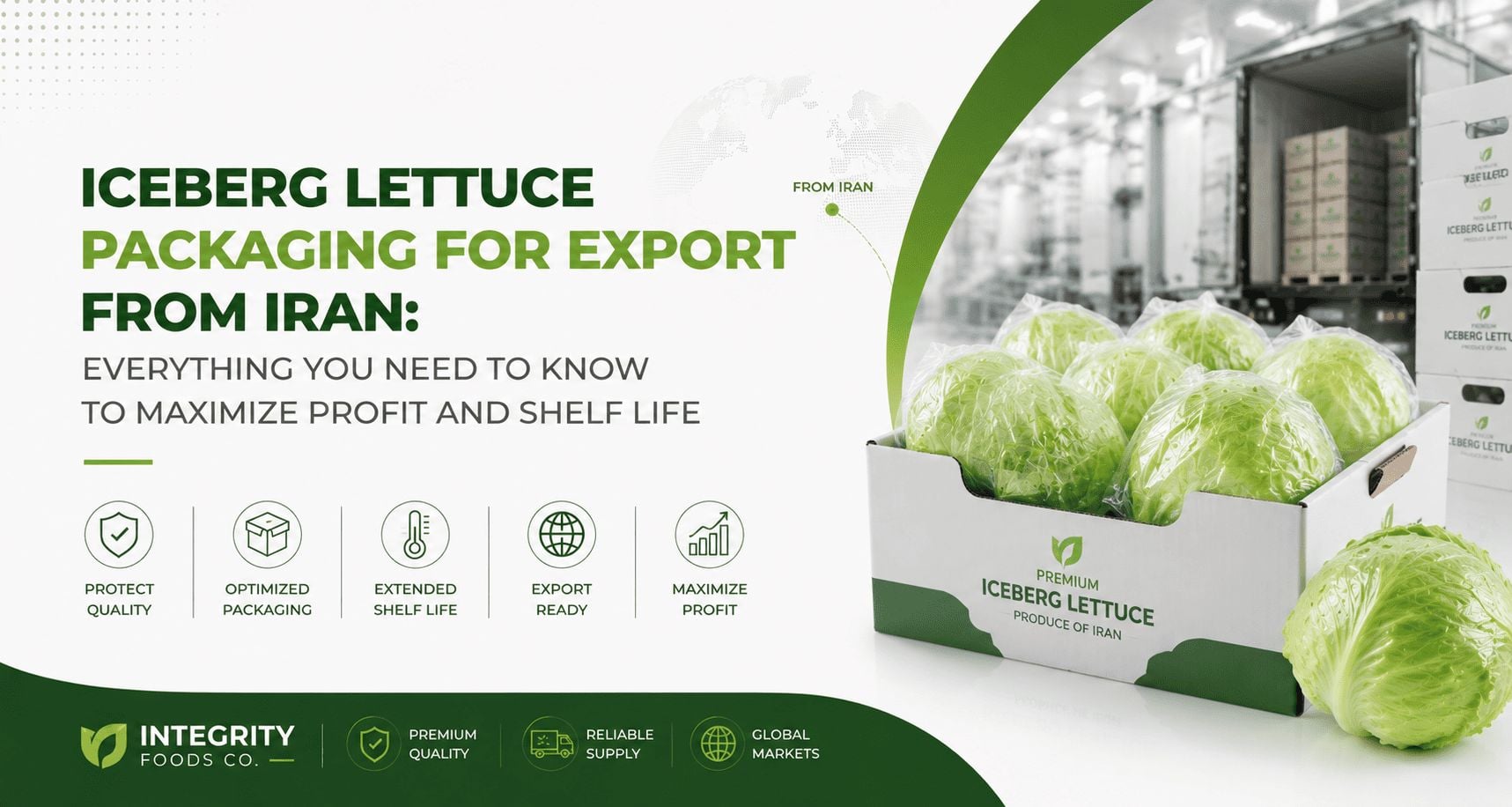


Iceberg Lettuce Packaging for Export from Iran: Everything You Need to Know to Maximize Profit and Shelf Life banner
Integrity Fruits Logo

Iceberg Lettuce Packaging for Export from Iran: Everything You Need to Know to Maximize Profit and Shelf Life

somayeh

By somayeh

Published June 12, 2026

It only takes a little damage for iceberg lettuce to quickly start to oxidize and turn black. On the other hand, this product only lasts 10 to 14 days in its whole and unwashed . Proper packaging plays an important role in its long-term shelf life, helping it stay crisp, juicy, and fresh for up to 4 weeks under the right conditions.

What packaging standards are required to ensure the product arrives intact and maintains its freshness throughout its journey?

In this article, we take a closer look at iceberg lettuce packaging for export from Iran and the key options available for international buyers.


How Iceberg Lettuce is Packed for Export from Iran?

Iceberg lettuce is highly sensitive to bruising and oxidation; even minor pressure or temperature fluctuations can significantly reduce its shelf life. For this reason, maintaining a stable cold chain from the farm to the destination market is essential. Any break in temperature control can lead to quality loss during transportation.

In addition to temperature management, we need a proper palletizing and airflow design inside refrigerated trucks, keeping the product fresh. Air must circulate evenly between crates and pallets to prevent heat pockets and moisture buildup. This also ensures consistent cooling across the load.

In practice, iceberg lettuce supplier and exporters from Iran use some packaging methods that preserve freshness, reduce physical damage, and maintain optimal temperature and humidity throughout the supply chain. But how iceberg lettuce is packed for shipping?


3 Different Iceberg Lettuce Export Packaging Standards

Iceberg lettuce exports from Iran typically rely on 3 main packaging standards, each offering a different balance of protection, cost, and logistics efficiency:

1)     Small Plastic Crates (8 heads per crate)

Small plastic crates are one of the most protective options, holding around 8 heads of lettuce. A standard refrigerated truck can accommodate approximately 2,400 of these small boxes.

Its main advantage is superior protection, as the lettuce is held more securely and experiences minimal movement during transport. This significantly reduces the risk of bruising or oxidation.

However, this method's initial cost is higher because more crates must be purchased, which increases upfront investment. Despite this, the reduction in product damage and high weight of load in each truck often leads to lower overall logistics costs.

2)     Large Plastic Crates (9–10 heads per crate)

Large plastic crates offer higher capacity, holding 9 or 10 heads per crate, with approximately 1,840 crates fitting in a refrigerated truck.

While this option improves loading efficiency, it has a drawback: the lettuce may come into contact with the crate walls, increasing the risk of leaf damage or slight opening of the heads. This method is more suitable for shorter or well-controlled transport routes.

3)     Cardboard Boxes

There are also cardboard boxes with a capacity of 10 lettuces, which can fit about 1,840 units per truck, which are often chosen for their low cost and light weight.

However, they are highly sensitive to moisture and have lower structural strength. Under long-distance or high-humidity conditions, they carry a higher risk of deformation and product damage, making them less reliable for extended international shipments.


Which Iceberg Lettuce Packaging for Export is the Best for Your Business?

As we've seen, each packaging method comes with its own advantages and limitations. Choosing the Best Packaging Method for Iceberg Lettuce to Russia and other markets depends on several critical factors: the transportation route, shipping method, transit time, budget, and destination-country regulations.

For example, Qatar only accepts iceberg lettuce packed in plastic crates, while shipments to Russia can utilize either plastic crates or cardboard boxes, depending on the buyer's requirements and preferences.

Among the available options, small plastic crates generally deliver the best performance. They provide better ventilation around each head of lettuce, reduce pressure on the product, and significantly lower the risk of bruising or internal damage. While they require a higher initial investment, the reduction in waste and product rejection often leads to higher overall profit margin, making them one of the most cost-effective solutions for long-distance exports such as those to Russia.


Conclusion

As we said the right iceberg lettuce packaging for export can help reduce product losses, maintain freshness throughout the supply chain, and maximize returns for both exporters and buyers. So, packaging is not just a visual or logistical choice; it is a direct economic decision that affects product quality, shelf life, and profitability.

 If you are looking for iceberg lettuce supplier or selecting the most suitable packaging option for your target market, the Integrity Fruits team is ready to help.
Related Articles
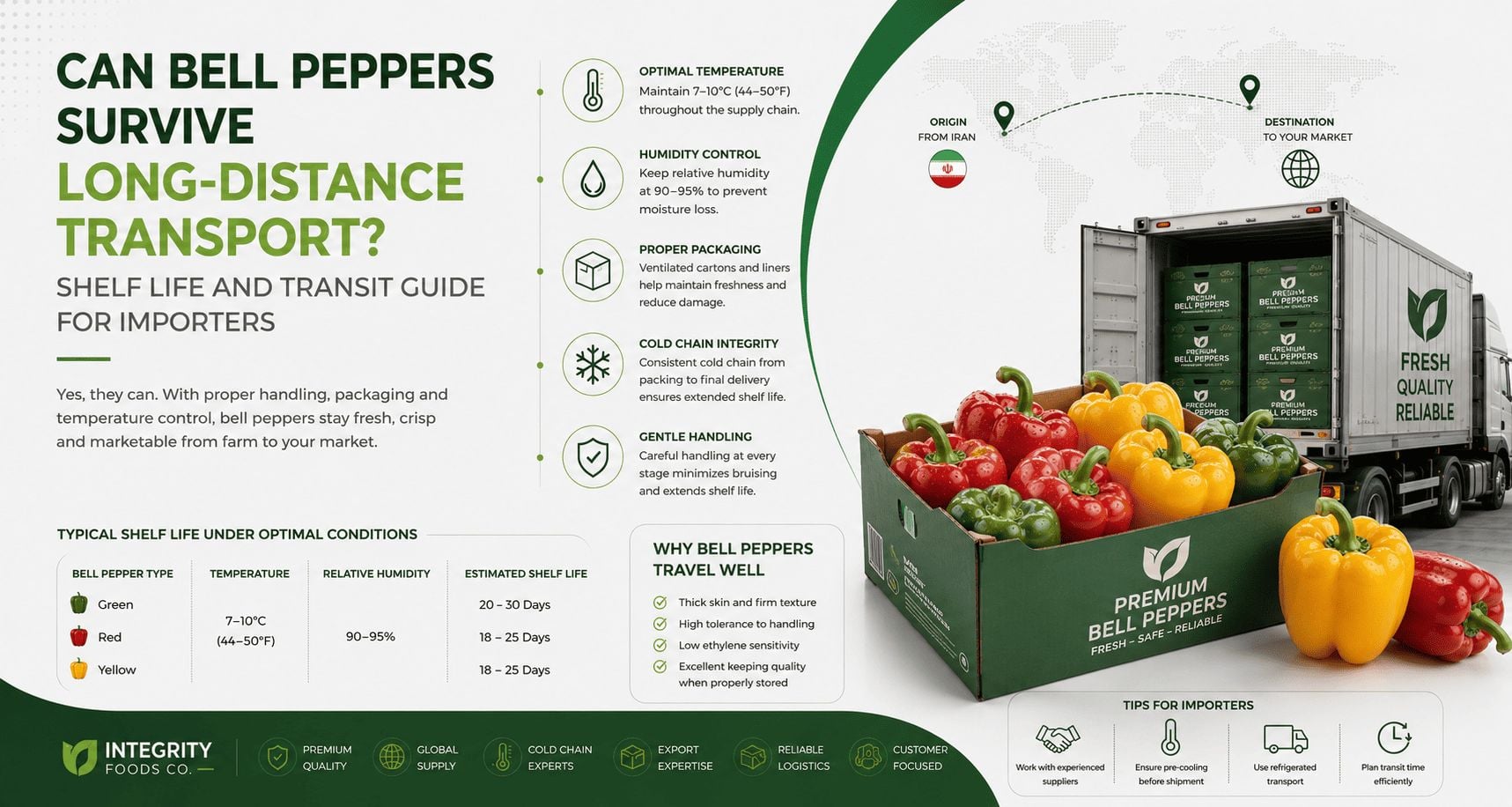
Can Bell Peppers Survive Long-Distance Transport? Shelf Life and Transit Guide for Importers
July 19, 2026

Can Bell Peppers Survive Long-Distance Transport? Shelf Life and Transit Guide for Importers

Shelf life is not just about freshness; It directly affects customer satisfaction, minimizes waste, and determines whether a shipment can be sold at its full value when it arrives. So If bell peppers lose their quality during long-distance transport, it translates into significant financial losses for importers and manufactures. Is there any solution?  Can bell peppers survive long-distance transport without losing their premium quality?  In this article, we will talk about this. Can Bell Peppers Survive Long-Distance Transport? The answer is a definitive yes. However, achieving this requires that every link in the supply chain is managed with precision. Under optimized conditions, specifically regarding harvesting, packaging, and climate control, fresh bell peppers can maintain high-quality standards for approximately 12 to 14 days during transit.  Key Factors In Maintaining Bell Pepper Shelf Life During Transport  Maintaining fresh bell pepper transit time quality requires a deep understanding of several interconnected variables. If any link in this chain fails, the risk of spoilage increases.  Harvest Stage  One of the most common mistakes in the export industry is harvesting peppers at the wrong maturity level. For long-distance shipping, bell peppers should not be fully ripe at the time of picking. Instead, they should be harvested at a stage where they are approximately 3/4 colored. This timing is essential because the final ripening process continues during transit. By selecting the correct maturity stage, the fruit retains its structural integrity for longer. In contrast, if peppers are harvested overripe, they quickly lose their firmness, leading to significant bell pepper damage during shipping . A professional fresh bell pepper supplier prioritizes this stage to ensure the product arrives crisp and firm. Packaging System  If cartons are stacked too high or loaded incorrectly, the mechanical pressure can crush the layers below. This is a common cause of bell pepper damage during shipping.  Furthermore, the arrangement of these cartons must be strategic; a poor layout can block essential airflow, creating hotspots that accelerate decay. Ventilation   Airflow is the lifeline of fresh produce during transit. Without proper ventilation, heat and moisture build up inside the carton. Poor airflow can speed up decay and reduce firmness. Good wholesale bell pepper transport quality depends on packaging that allows the peppers to breathe. Temperature Control  Temperature has a direct influence on pepper firmness, respiration rate, and overall shelf life. If the container temperature becomes unstable or too warm, the peppers will soften rapidly, losing their freshness and value. So the temperature effect on bell peppers must be controlled from packing to delivery. Conclusion  Ultimately, the safe arrival of bell peppers depends on a correct harvest stage, proper packaging, good ventilation, temperature control, and careful stacking. When these factors are managed with expertise, bell peppers can travel long distances while remaining fresh, firm, and highly attractive to the market. If you are looking for a reliable Iranian bell pepper supplier with export-ready packing and logistics support, Integrity Fruit is your strategic partner. We connect international importers with trusted Iranian producers, managing everything from expert packaging to complex global logistics to ensure your shipment arrives in perfect condition. 

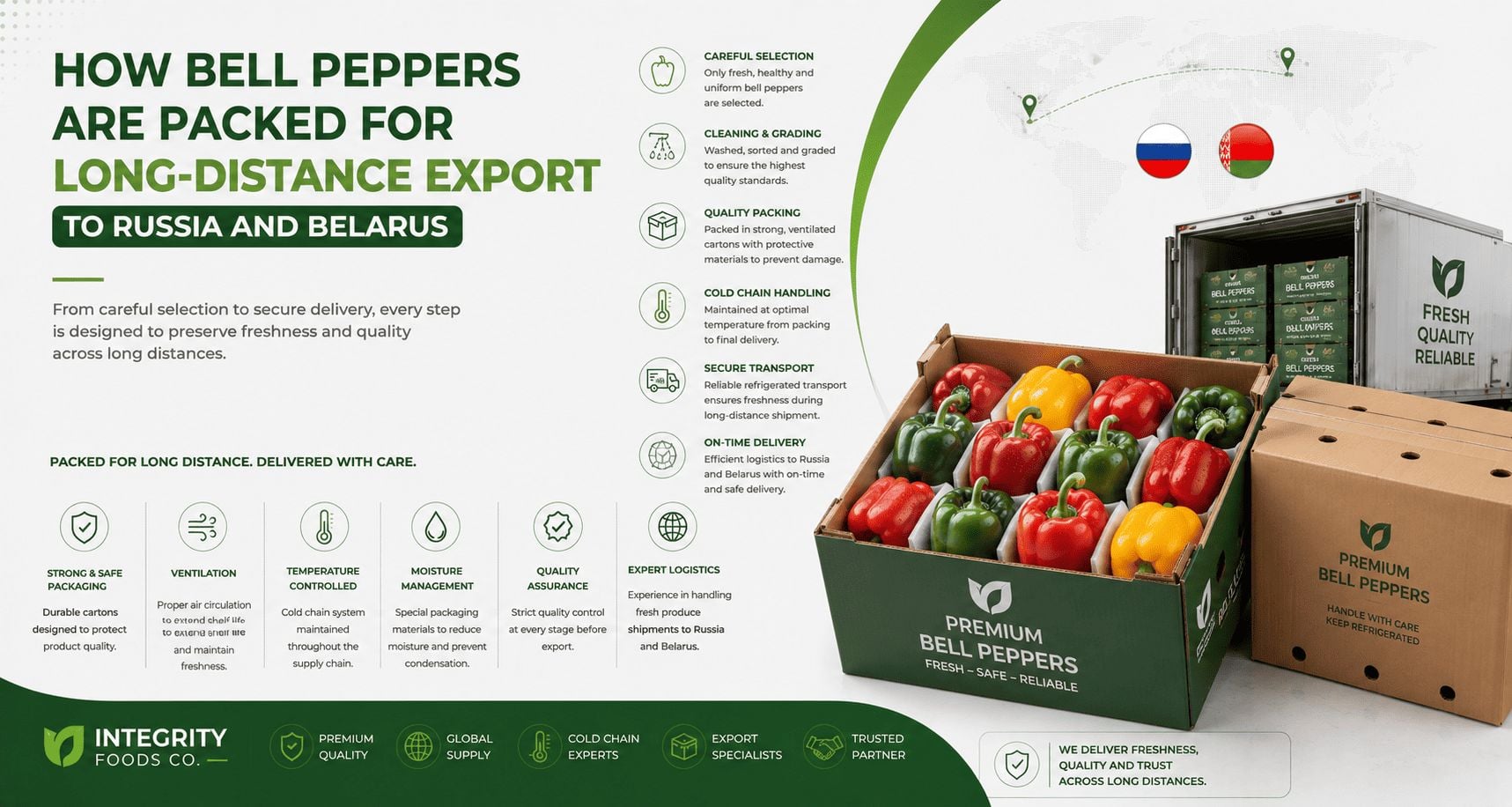
How Bell Peppers Are Packed for Long-Distance Export to Russia and Belarus
July 8, 2026

How Bell Peppers Are Packed for Long-Distance Export to Russia and Belarus

When we talk about bell pepper shipping from Iran to Russia and Belarus, we are looking at a journey that typically lasts 12 to 14 days by road. For any professional wholesale bell pepper supplier , the goal is simple but challenging: making sure the peppers arrive at the destination looking as fresh as the day they were picked. But how? What makes a successful long-distance shipment possible? In this article, we will explore the essential strategies used to ensure quality from farm to destination.  3 Common Causes of Damage During Transport Before discussing packing methods, it is important to understand the main causes of damage during transport. Here are the 4 most common problems we see: 1. Excessive Moisture and Poor Ventilation  If air can’t circulate, humidity builds up and this moisture is a magnet for mold. Peppers need to breathe and we should ensure there is a proper airflow inside the container. 2. Improper Stacking When the boxes are stacked too high without proper support, the entire load can shift or collapse, causing massive physical damage. 3. Temperature Fluctuations If the refrigerator unit in the truck changes temperature frequently, the peppers will suffer from chilling injury or heat stress, both of which cause the skin to wrinkle and soften. How to Prevent Bulk Bell Peppers from Damage During International Transport Protecting the fruit depends on two key elements: timing and technique. Let’s look at them: Harvest Timing Many people think peppers should be fully ripe when picked. However, for long-distance shipping, this is not true. If you pick a pepper that is already fully colored and soft, it will likely spoil or become mushy before it reaches Moscow or Minsk. To prevent bulk bell peppers from damage during international transport, farmers must harvest them when they are physically firm but not yet at their final color. During the 12–14 day transit, the peppers continue to ripen naturally inside the container.  By the time they arrive at the warehouse, they reach their perfect color. With this method, farmers master how to avoid fruit and vegetable spoilage during international shipping . Technique of Packing As we’ve seen, bell pepper shelf life during shipping for import depends heavily on how they are treated inside the box. It isn’t enough to just have a cold truck; the internal arrangement is what keeps the fruit stable. While using high-quality carton-plast (corrugated plastic) boxes is the industry standard, the way you layer them is what truly matters. A very common mistake is placing smaller peppers at the bottom of the box. The weight of larger peppers can put pressure on smaller ones, leading to bruising and faster deterioration. To ensure quality, always build a stable foundation by placing your largest, sturdiest peppers at the bottom, and carefully layer the medium and smaller sizes on top. This protects the integrity of every single piece in the shipment. Conclusion Knowing how are bell peppers packed for export  to Russia and Belarus, from selecting the perfect maturity stage to mastering the stacking order, is what separates a successful supplier from one who loses profit to spoilage. At Integrity Fruit , we understand these complexities. We ensure that your Iranian bell peppers are handled with precision, so they reach the Russian and Belarusian markets in perfect, market-ready condition.

Wholesale Bell Pepper Supplier in Iran: Supply, Quality and Logistics Guide for Importers
July 4, 2026

Wholesale Bell Pepper Supplier in Iran: Supply, Quality and Logistics Guide for Importers

Growing bell peppers is difficult in Russia and Belarus because of the weather, which means most of the supply has to come from imports. This makes finding a reliable source very important for your business. You don’t just need peppers; you need a partner you can trust to deliver high-quality products every time. If you are searching for a dependable wholesale bell pepper supplier , understanding how Iranian production, harvesting, and specialized packaging work is essential to making a profitable sourcing decision. Why Iranian Wholesale Bell Pepper Supplier? ّFor businesses that require large and regular shipments, working with a bulk bell pepper supplier in Iran provides both flexibility and supply security. Year-Round Greenhouse Production in Iran  One of the biggest advantages of working with an Iranian bell pepper supplier is consistency. Iran has a large network of modern greenhouses that operate year-round, allowing suppliers to deliver fresh bell peppers in every season. Companies also interested in importing bell pepper from Iran often choose greenhouse products because of their uniform size, appearance, and shelf life. This year-round production capacity allows suppliers to maintain continuous availability and support long-term contracts with wholesalers, retailers, and distributors in international markets. We work closely with greenhouse bell pepper suppliers that follow controlled production cycles and consistent quality standards. This enables us to respond to changing market demands while maintaining a stable flow of products throughout the year. Harvesting Bell Peppers for Maximum Freshness  In the export business, timing is everything. If bell peppers are harvested too late, they become overly sensitive, leading to bruising and rapid decay during transit. To ensure maximum freshness, we prioritize harvesting at the precise moment of commercial maturity. The peppers are picked when they are firm and healthy, but still possess the resilience needed for long-distance travel. This allows them to continue maturing naturally in the supply chain, arriving at your warehouse with the exact texture and appearance your customers expect. Export Packaging Designed for Freshness One of the most common reasons for quality loss during the long journey to other countries is moisture buildup within the packaging. Traditional cardboard boxes often lose their strength when exposed to humidity, leading to crushed produce and wasted shipments. To eliminate this risk, we utilize plastic corrugated cartons (PP corrugated sheets). These specialized containers are moisture-resistant and maintain their structural integrity even in varying environmental conditions. As a result, every shipment remains ventilated, dry, and physically protected from the moment it leaves the greenhouse until it reaches your facility. If you are also sourcing leafy greens, we recommend reading our detailed guide on ' Iceberg Lettuce Packaging for Export from Iran ' to understand how we maintain crispness and prevent dehydration for delicate produce. Flexible Color Combinations for Different Markets We understand that the demand in Moscow might differ from that in Minsk. Our supply chain is designed for flexibility. While red bell peppers typically form the core of most orders, we can easily adjust the ratio of yellow and other varieties to match your specific retail or distribution strategy.  By connecting buyers with greenhouse bell pepper supplier in Iran, we help customize product specifications based on retail demand and distribution strategies. Logistics and Transportation to Russia and Belarus Reliable logistics are a key part of every successful export operation. From farm selection and quality control to loading and transportation, every stage is carefully coordinated to preserve freshness throughout the journey. Maintaining the cold chain, using proper loading techniques, and selecting suitable transport routes all contribute to reducing losses and protecting product quality. At Integrity Fruit , we manage the entire process to minimize transit losses and keep the freshness gap to an absolute minimum. Conclusion For companies seeking a reliable wholesale bell pepper supplier , Iran offers an attractive combination of year-round greenhouse production, competitive pricing, flexible product specifications, and well-established export capabilities. Whether you need a bulk bell pepper supplier for large-volume purchases or a long-term one for ongoing cooperation, the country's greenhouse industry provides dependable solutions for international buyers.

Iceberg Lettuce Import from Iran to Russia and the CIS Markets: Trends, Supply and Opportunities
June 15, 2026

Iceberg Lettuce Import from Iran to Russia and the CIS Markets: Trends, Supply and Opportunities

According to the OEC report, a data visualization and distribution platform, Russia imported $12.4M of lettuce in 2024, making it the 38th largest importer of lettuce in the world. Russia fresh vegetables import data continue to grow, reflecting its people’s continued demand for fresh produce. This growth of iceberg lettuce statistics in Russia is also visible across CIS countries. And Iran has long been one of their key suppliers. This article examines the trends in iceberg lettuce import from Iran to Russia and the CIS , including supply capabilities and market opportunities.   Iceberg Lettuce Import from Iran to Russia and the CIS Iran has exported 183,000 tons of iceberg lettuce between March 2025 and January 2026 alone, with the share of countries shown below: Country Name Weight (Tons) Russia 69,000 Belarus 2,400 Armenia 130 United Arab Emirates (UAE) 34,000 Iraq 66 Oman 1,200 Kyrgyzstan 265 Kazakhstan 2,355 Georgia 1,900 As you can see, a significant share of this volume has gone to Russia and CIS markets, reflecting strong trade relations and growing demand . They import a considerable portion of their fresh vegetables from international markets because their climatic conditions are not suitable for year-round cultivation of lettuce and other vegetables. It seems that Iran has managed to establish a strong position in their market. The statistics show how strong the demand for Iranian iceberg lettuce is and what an important role we play in the international market for this product. Why Is Importing Iranian Lettuce a Good Opportunity? Several factors make Iranian iceberg lettuce attractive to importers in Russia and the CIS region: 1)      Year-round Supply: Iran can supply fresh iceberg lettuce throughout much of the year thanks to its diverse agricultural regions and favorable growing conditions. This helps buyers secure a stable supply even when production in other countries is limited. 2)       Logistical Efficiency: Shorter transportation routes allow products to reach their destination faster. Faster delivery helps maintain freshness and reduces post-harvest losses, which is particularly important for leafy vegetables. 3)     Competitive Pricing: Lower transportation costs combined with strong agricultural production enable Iranian exporters to offer quality products at attractive prices. 4)     Market Expertise: Many experienced iceberg lettuce suppliers in Iran for Russia and the CIS are already active in serving international markets. So, they can meet the quality and packaging requirements of wholesale buyers, distributors, and retail chains.   What Is the Import Process for Iceberg Lettuce from Iran? As import trends continue to show growth across Russia and the CIS, more buyers are looking for reliable sourcing partners in Iran and efficient ways to manage the import process. Importing iceberg lettuce from Iran is a straightforward process when working with an experienced supplier or sourcing partner. The process typically involves a few key steps. 1. Find a Reliable Supplier Choosing a reliable Iran iceberg lettuce supplier for Russia and the CIS is the first and most important step in the import process. You should evaluate factors such as production capacity , product quality , export experience , certifications, and previous export destinations . 2. Confirm Product Specifications Once a supplier has been selected, both parties agree on the product specifications. This usually includes lettuce size, quality grade, packaging type, order volume, delivery schedule, and pricing. At this stage, exporters may also provide product photos , samples , or quality reports . 3. Arrange Packaging and Export Documentation Fresh vegetables require suitable packaging to maintain quality during transportation. Export documentation, including invoices, packing lists, phytosanitary certificates, and customs documents, must also be prepared before shipment. 4. Organize Transportation Depending on the destination, iceberg lettuce is usually transported by refrigerated trucks to Russia and neighboring CIS countries. Proper cold-chain logistics help preserve freshness and reduce product losses during transit. 5. Customs Clearance and Delivery After arrival, shipments go through customs clearance before being delivered to warehouses or retail distribution centers. Working with experienced partners helps simplify the entire iceberg lettuce import process into Russia from sourcing to final delivery.   Final Thoughts The future of Iceberg lettuce import from Iran to Russia and the CIS looks promising due to increasing demand in the region. So, if you are also looking to take advantage of these market opportunities, the Integrity Fruits team can help you identify reliable suppliers, evaluate product quality, coordinate logistics, and streamline the sourcing process. Contact our experts today for professional guidance on sourcing iceberg lettuce from Iran.